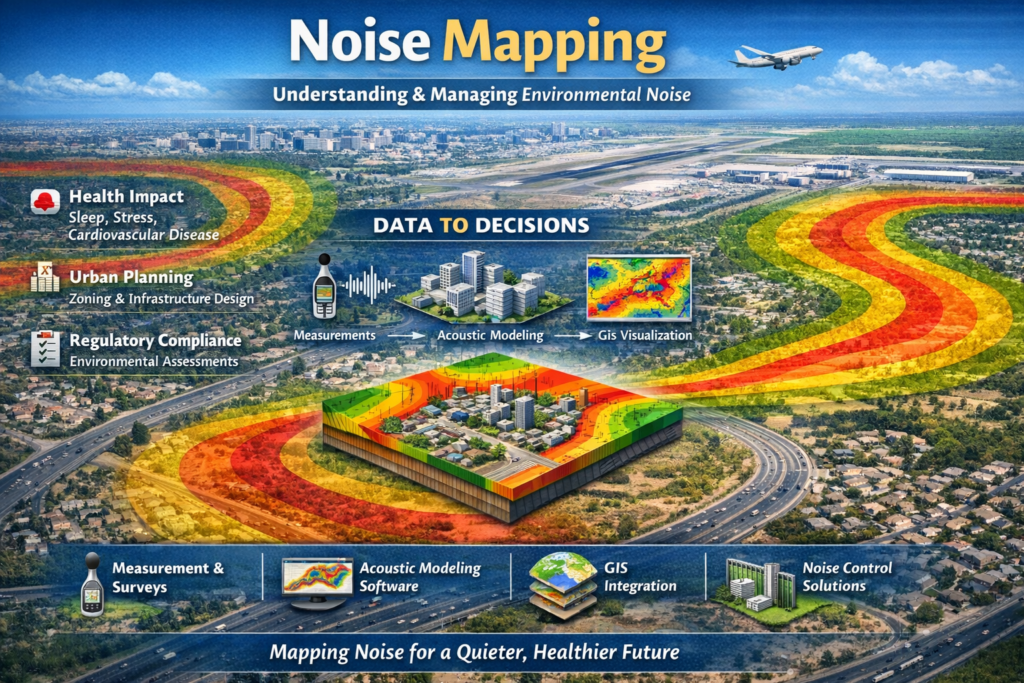
Noise Mapping: Science, Significance, and Future of Managing Environmental Noise
Introduction
Noise pollution is often described as the invisible pollutant—unseen, yet profoundly impactful. Rapid urbanization, industrial expansion, traffic density, and infrastructure growth have made environmental noise a critical public health and planning challenge across the world. Unlike air or water pollution, noise cannot be captured or stored, yet its effects on human health, ecosystems, and quality of life are immediate and cumulative.
In this context, noise mapping has emerged as one of the most powerful scientific and decision-making tools for understanding, managing, and mitigating environmental noise. By transforming complex acoustic data into intuitive spatial visualizations, noise mapping bridges the gap between science, policy, engineering, and community well-being.
What Is Noise Mapping?
Noise mapping is the systematic process of predicting, modeling, and visualizing noise levels across a geographical area using scientifically validated acoustic algorithms, mathematical models, and spatial data.
A noise map typically represents:
- Sound pressure levels (dB(A)) over land
- Noise contours and exposure zones
- The spatial influence of multiple noise sources such as industry, traffic, railways, airports, and urban activities
Modern noise maps are developed using advanced computational platforms such as SoundPLAN and CadnaA, often integrated with GIS environments like ArcGIS or QGIS for precise spatial interpretation and planning.
Why Noise Mapping Is Needed
1. Increasing Noise Exposure
A large share of the global population is now exposed to noise levels exceeding recommended health limits, especially in urban and industrial regions.
2. Health and Well-being
Scientific studies link chronic noise exposure to:
Sleep disturbance
Cardiovascular diseases
Cognitive impairment
Stress and reduced productivity
Noise mapping helps quantify exposure, enabling proactive health‑based interventions.
3. Regulatory Compliance
Environmental regulations—national and international—require objective assessment of noise impacts during:
- Environmental Impact Assessments (EIA)
- Consent and permitting processes
- Urban master planning
Noise maps provide defensible, auditable evidence for compliance.
Core Functions of Noise Mapping
Noise mapping serves multiple stakeholders and objectives:
1. Assessment
It identifies high‑noise zones and sensitive receptors (residential areas, schools, hospitals, ecological zones).
2. Prediction
It predicts future noise scenarios considering:
- Increased traffic or production capacity
- New industrial installations
- Infrastructure expansion
3. Planning & Design Support
Noise maps guide:
- Plant layout optimization
- Buffer zone planning
- Placement of noise barriers and enclosures
- Building orientation and zoning strategies
4. Communication
Noise maps translate technical acoustic data into clear visual formats, enabling transparent communication with authorities, clients, and the public.
Importance of Noise Mapping in Modern Society
Urban & Regional Planning
Strategic noise mapping supports sustainable city development by integrating acoustics into land-use planning.
Industrial & Infrastructure Projects
For refineries, petrochemical plants, highways, and airports, noise mapping is essential for:
- Design-stage risk reduction
- Cost-effective noise control solutions
- Long-term operational compliance
Environmental Justice
By spatially correlating noise exposure with population density, noise maps help address inequality in environmental burdens.
Methods Used in Noise Mapping
Noise mapping relies on a combination of measurement, modeling, and spatial analysis:
1. Baseline Noise Surveys
Field measurements establish existing ambient conditions and validate model assumptions.
2. Acoustic Modeling
Specialized software (e.g., SoundPLAN, CadnaA) applies internationally recognized prediction algorithms for:
- Industrial noise
- Road and rail traffic
- Aircraft operations
3. Digital Terrain and Geometry Integration
Topography, buildings, barriers, and ground absorption effects are incorporated using CAD and GIS‑based datasets.
4. GIS-Based Spatial Visualization
GIS platforms enable:
- Layered environmental analysis
- Population exposure mapping
- Decision-oriented spatial outputs
The Role of Advanced Software & GIS
SoundPLAN & CadnaA
These platforms are widely recognized as industry standards for environmental noise prediction due to:
- Robust scientific models
- Multi-source integration
- 2D and 3D noise visualization
- Compatibility with international standards
ArcGIS and Spatial Intelligence
GIS tools enhance noise mapping by adding:
- Demographic overlays
- Land-use classification
- Health and infrastructure correlations
Together, acoustic software and GIS form a powerful digital ecosystem for noise governance.
Noise Mapping and the Future of Noise Pollution Control
Noise mapping is no longer just a reporting tool—it is evolving into a predictive and strategic environmental management system.
Include Future Trends:
- Smart city integration with real-time monitoring
- Digital twins of urban and industrial environments
- AI-supported scenario analysis
- Climate-resilient noise planning
- Health‑oriented exposure modeling
As sustainability, ESG performance, and human-centric design gain prominence, noise maps will play a central role in responsible development.
Conclusion
Noise mapping represents the convergence of science, technology, planning, and public health. It transforms sound into insight, data into decisions, and complexity into clarity.
In a world where development must coexist with livability, noise mapping is not optional—it is essential. For governments, industries, consultants, and communities alike, it provides the foundation for informed action and a quieter, healthier future.
“You cannot manage what you do not measure—and you cannot mitigate what you do not understand. Noise mapping makes the invisible audible.”
Nice