Abstract
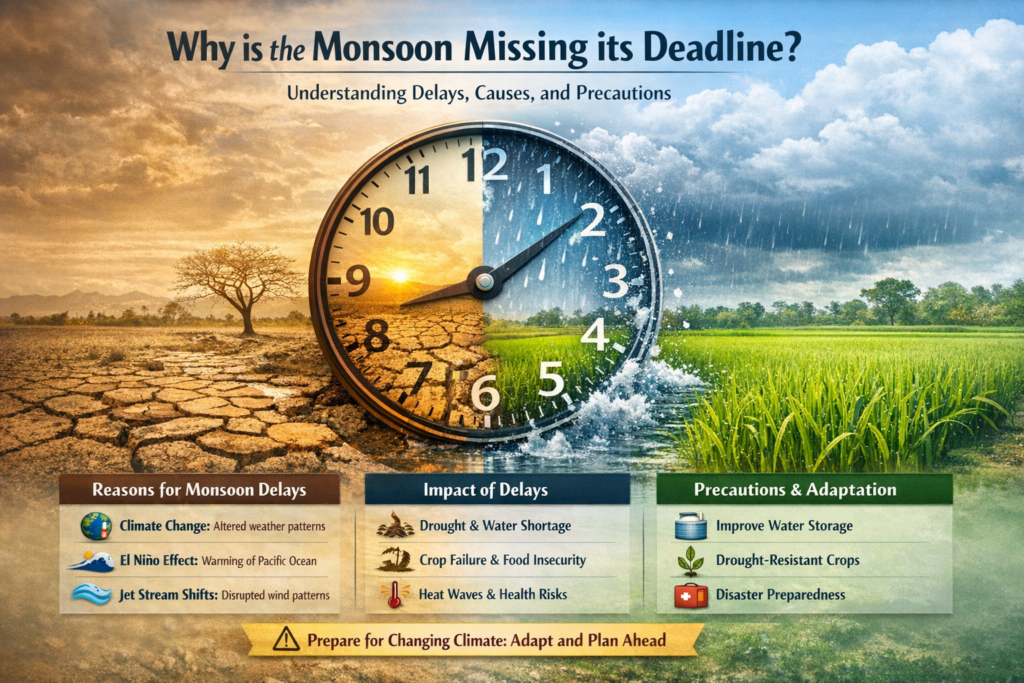
The Indian monsoon is the backbone of the country’s climate, agriculture, and water resources. In recent years, however, concerns have grown over delayed onset, erratic rainfall, and shifting monsoon patterns. This article examines whether the monsoon is “missing its deadline,” the scientific reasons behind such variability, and the necessary precautions for adaptation and resilience.
Keywords
Monsoon variability, climate change, ENSO, rainfall delay, environmental impact, adaptation strategies, India climate
1. Introduction
Traditionally, the southwest monsoon reaches Kerala around June 1 and gradually advances across India. However, deviations from this schedule are increasingly observed. While short delays are natural, frequent irregularities raise concerns about climate variability and long-term environmental change.
2. Is the Monsoon Really Delayed?
It is important to clarify that:
- The monsoon is a dynamic atmospheric system, not a fixed-time event.
- “Deadline” is a statistical average, not a strict rule.
- Delays of 5–10 days are considered normal variability.
However, in recent decades:
- Erratic onset and uneven distribution of rainfall have increased.
- There are long dry spells followed by intense rainfall events.
👉 This indicates not just delay, but increased unpredictability.
3. Key Causes of Monsoon Delay and Variability
3.1 Climate Change
- Rising global temperatures alter land-sea temperature gradients, which drive monsoon circulation.
- Leads to weaker or shifting monsoon winds.
- Increases frequency of extreme weather events.
3.2 El Niño–Southern Oscillation (ENSO)
- El Niño events cause warming of the Pacific Ocean.
- This weakens the Indian monsoon by:
- Reducing moisture transport
- Disrupting atmospheric circulation
3.3 Indian Ocean Dipole (IOD)
- Variations in sea surface temperature in the Indian Ocean affect rainfall.
- Positive IOD can enhance monsoon, while negative IOD may suppress it.
3.4 Jet Stream and Wind Pattern Changes
- Shifts in upper atmospheric winds:
- Delay monsoon onset
- Cause uneven rainfall distribution
3.5 Urbanization and Land Use Change
- Increased heat islands in cities
- Changes in vegetation cover
- Affect local and regional rainfall patterns
4. Environmental and Socio-Economic Impacts
4.1 Agriculture
- Delayed sowing cycles
- Crop stress and yield reduction
- Increased risk of crop failure
4.2 Water Resources
- Reduced reservoir recharge
- Groundwater depletion
- Drought conditions in many regions
4.3 Public Health
- Heatwaves extend due to delayed rains
- Water scarcity affects hygiene and health
- Sudden heavy rains may cause flooding and disease outbreaks
4.4 Infrastructure and Urban Flooding
- Poor drainage systems fail during intense rainfall
- Increased risk of urban flooding (e.g., Mumbai)
5. Precautions and Adaptation Measures
5.1 Water Resource Management
- Rainwater harvesting systems
- Efficient reservoir operation
- Wastewater recycling and reuse
5.2 Climate-Resilient Agriculture
- Use of drought-resistant crop varieties
- Adjusting sowing schedules based on forecasts
- Micro-irrigation techniques (drip/sprinkler)
5.3 Early Warning Systems
- Improved meteorological forecasting
- Real-time weather data dissemination
- Community-level preparedness
5.4 Urban Planning and Infrastructure
- Stormwater drainage improvements
- Flood zoning and risk mapping
- Green infrastructure (permeable surfaces, urban forests)
5.5 Energy and Heat Actions
- Heatwave management plans
- Energy-efficient cooling systems
- Public awareness on heat safety
6. Way Forward
The changing behavior of the monsoon highlights the need for:
- Integrated climate adaptation strategies
- Stronger environmental governance
- Technological interventions (AI-based forecasting, climate models)
Rather than focusing only on delays, the emphasis must shift to resilience against variability.
7. Conclusion
The monsoon is not strictly “missing its deadline,” but it is undeniably becoming more erratic and less predictable due to climate and anthropogenic factors. This new reality demands a transition from reactive responses to proactive planning, ensuring environmental sustainability and socio-economic stability.