In industries such as petrochemical, oil & gas, refineries, power plants, and large process facilities, effective noise management is a critical component of health, safety, environmental compliance, and sustainable plant design.
Noise limits are defined at different levels to systematically control noise from the source, protect personnel, and safeguard the surrounding environment.
Key Noise Limits Used in Industry
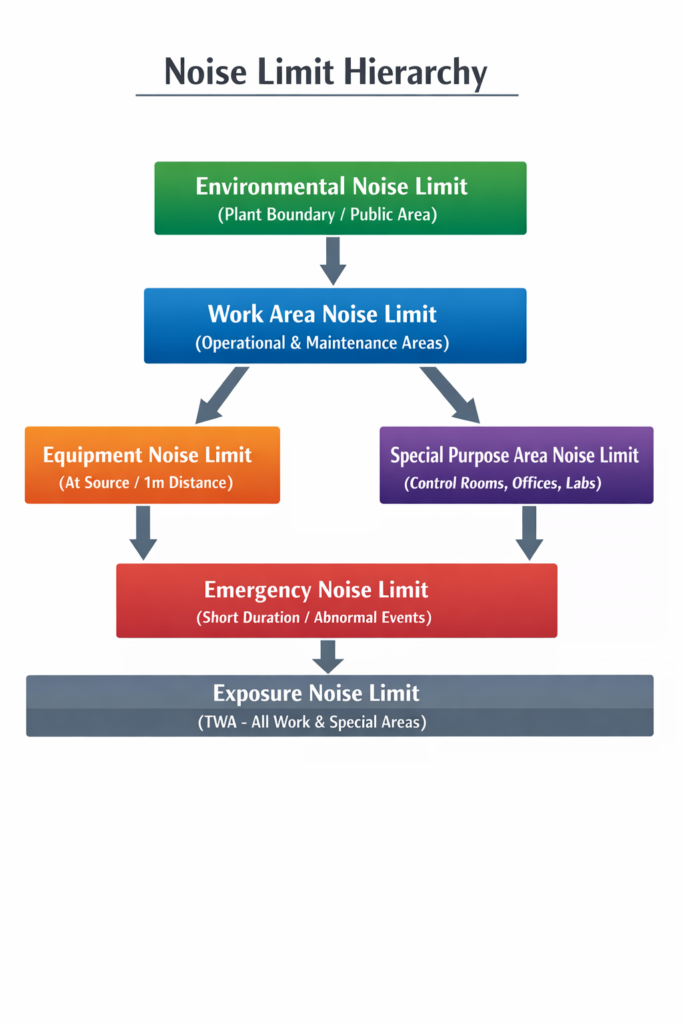
Equipment Noise Limit
This defines the maximum allowable noise level emitted by individual equipment (e.g., pumps, compressors, DG sets), typically measured at 1 meter from the source. Controlling noise at the equipment level is the first step toward achieving overall plant compliance.
Work Area Noise Limit
Work area noise limits specify acceptable sound levels in operational and maintenance areas where personnel are regularly present. These limits ensure safe working conditions and support long‑term hearing protection.
Special Purpose Area Noise Limit
Stricter noise criteria apply to noise‑sensitive areas such as control rooms, offices, laboratories, and shelters. Lower noise levels are essential here to maintain clear communication, concentration, and operator efficiency.
Exposure Noise Limit
Exposure limits define the time‑weighted average (TWA) noise level to which personnel may be exposed, commonly 85 dBA over an 8‑hour period. These limits form the basis of hearing conservation programs and PPE requirements.
Emergency Noise Limit
During abnormal or emergency operations (such as pressure safety valve lifting or blowdown events), higher noise levels may be temporarily permitted, provided exposure duration is limited and controlled through procedures and access restrictions.
Environmental Noise Limit
Environmental noise limits apply at the plant boundary and nearby residential or commercial receptors. These limits ensure compliance with local and international regulations and protect the surrounding community from excessive noise impact.
A Structured Noise Control Approach
All these limits work together in a hierarchical manner—from controlling noise at the equipment source, to managing workplace exposure, and finally protecting the environment and public.
This layered approach enables engineers to design effective noise mitigation measures such as acoustic insulation, enclosures, barriers, and layout optimization.
Conclusion
A clear understanding of industrial noise limits supports:
- Safe and compliant plant design
- Protection of personnel hearing
- Regulatory and environmental compliance
- Efficient noise control engineering decisions
In complex industrial projects, structured noise criteria provide a practical and reliable framework for managing noise throughout the full project lifecycle—from design and procurement to operation.