Noise Pollution: Sources, Measurement, Impacts, Standards, and Control Measures
Noise pollution has become one of the fastest-growing environmental concerns across urban and industrial regions. Unlike other pollutants, noise leaves no residue in the environment, yet its consequences on human health, well-being, and productivity are profound. Understanding the sources, measurement methods, health impacts, regulatory standards, and control strategies is crucial for creating quieter and healthier communities.
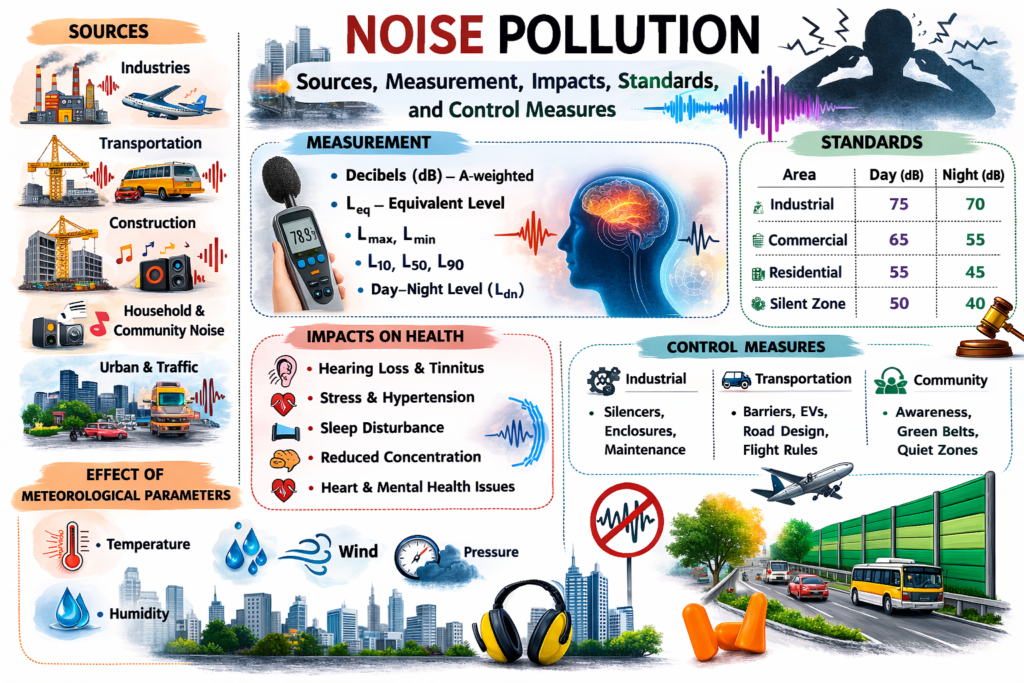
1. Sources of Noise Pollution
Noise pollution arises from a variety of natural and man-made activities. Major sources include:
a) Industrial Sources
- Heavy machinery
- Boilers, generators, compressors
- Metal cutting, grinding, forging operations
b) Transportation Sources
- Road traffic (cars, trucks, buses, two-wheelers)
- Rail traffic (locomotives, horns, track noise)
- Air traffic (aircraft takeoff, landing, ground operations)
c) Construction and Urban Activities
- Building construction, demolition
- Excavation and road repair
- Stone cutting, drilling, concrete mixing
d) Household and Community Noise
- Loudspeakers, music systems
- Domestic appliances (vacuum cleaners, mixers)
- Social events, festivals, and fireworks
2. Measurement of Noise and Noise Indices
Noise is measured in decibels (dB) using a Sound Level Meter (SLM). Because human ears respond differently to various frequencies, measurements typically use A-weighting, expressed as dB(A).
Common Noise Measurement Metrics
a) L<sub>eq</sub> – Equivalent Continuous Noise Level
Represents a constant noise level that contains the same acoustic energy as varying levels over a given time.
b) L<sub>max</sub> and L<sub>min</sub>
- Lmax: Highest recorded sound level
- Lmin: Lowest recorded sound level
c) L10, L50, L90
- L10: Level exceeded for 10% of the measurement period (indicates traffic peaks)
- L50: Median level
- L90: Background noise level
d) Day-Night Level (L<sub>dn</sub>)
Adds a 10 dB penalty to nighttime noise (commonly used in urban planning).
e) Noise Pollution Level (L<sub>NP</sub>)
A composite index considering both equivalent noise and background variation.
3. Effect of Meteorological Parameters on Noise Propagation
Environmental and weather conditions significantly influence how noise travels.
a) Temperature
- Warm air near the ground causes sound to bend upward → reduced ground-level noise
- Cooler surface temperatures cause downward refraction → increased noise levels
b) Humidity
Higher humidity enhances sound transmission due to lower atmospheric absorption.
c) Wind Speed and Direction
- Downwind: Sound waves are carried further → higher noise impact
- Upwind: Sound is pushed back → reduced noise propagation
d) Atmospheric Pressure
Lower pressure slightly increases sound absorption, reducing noise levels.
e) Rain and Fog
- Rain absorbs high-frequency noise
- Fog increases sound propagation by creating a stable atmosphere
4. Noise Exposure Level and Standards
Various national and international agencies prescribe safe noise limits to protect public health.
Typical Acceptable Noise Levels
| Zone / Area | Daytime Limit (dB(A)) | Nighttime Limit (dB(A)) |
|---|---|---|
| Industrial Area | 75 | 70 |
| Commercial Area | 65 | 55 |
| Residential Area | 55 | 45 |
| Silent Zone (hospitals, schools) | 50 | 40 |
(Values may vary slightly depending on national regulations.)
Occupational Exposure Standards
- Maximum permissible exposure for workers:
- 90 dB(A) for 8 hours (with decreasing exposure time allowed as noise increases)
- Impulse noises and instantaneous peaks are also regulated due to extreme harm risk.
5. Impact of Noise on Health
Noise affects physical, mental, and social well-being.
a) Physiological Impacts
- Hearing loss and tinnitus
- Increased heart rate and blood pressure
- Stress hormone release and cardiovascular risks
b) Psychological Impacts
- Irritability, anxiety
- Sleep disturbances
- Reduced concentration and productivity
c) Cognitive and Behavioral Effects
- Impaired learning in children
- Reduced job performance
- Increased accident rates due to distraction
d) Social Impacts
- Communication interference
- Community disputes
- Lower overall quality of life
6. Control of Noise Pollution
Effective noise control requires a multi-layered strategy involving engineering controls, land-use planning, and public awareness.
A) Control of Industrial Noise
1. At the Source
- Regular maintenance of machinery
- Replacing old or noisy equipment
- Use of vibration isolators, silencers, mufflers
2. Along the Pathway
- Acoustic enclosures around noisy machines
- Sound-absorbing materials on floors, walls, ceilings
- Noise barriers and sound-proof partitions
3. At the Worker Level
- Providing earplugs or earmuffs
- Rotating workers to reduce exposure time
- Implementing “quiet zones” within facilities
B) Control of Transportation Noise
1. Road Traffic Noise
- Better road design, smoother surfaces
- Restrictions on honking
- Sound barriers along highways
- Promoting electric vehicles
2. Rail Traffic Noise
- Rail grinding to reduce friction
- Noise barriers near tracks
- Upgrading locomotives and brakes
3. Aircraft Noise
- Optimized flight paths
- Regulations on night flights
- Use of quieter engine technologies
Conclusion
Noise pollution is an invisible threat with far-reaching impacts on health and the environment. By understanding its sources, measurement techniques, regulatory standards, and control strategies, society can move toward creating quieter, healthier spaces. Governments, industries, and individuals must collaborate to implement sustainable solutions that reduce noise at its source and protect communities from its harmful effects.